“The business of animal suffering and death”

Last weekend I received the following e-mail:

The website of Lab-Animal-Training offers courses that train people to “carry out procedures on animals” and to “kill animals,” activities referred to on your website as “EU Function A” and “EU Function D.”

You call this “laboratory animal science,” but it is, in reality, the business of animal suffering and death. You profit from training people to ignore the most basic ethical principles.

The e-mail was sent to a number of recipients. For some reason, I and a colleague in Switzerland were singled out as individuals among a list of mainly organisations. Given the content, I assume that we were all chosen as having a role in training scientists for doing experiments with animals. The functions referred to are the ones of Article 34 in Directive 2010/63/EU which is the legislation regulating the use of animals in research in the EU, and one of the many things the Directive covers is the requirement for training before doing any work that involves animals.

I totally understand that it is disturbing that there are training courses with the focus on killing animals, in particular when it is as explicit as the Directive is about that this is precisely what it is. I appreciate that the Directive is not using euphemisms here; we all need to be aware of that what we are doing when we are ending the life of an animal is to kill it. And it doesn’t qualify for the term euthanasia unless it would be in the animal’s own interest and this is only the case for terminally ill animals for which nothing else can be done.

But there is a weird assumption of cause and effect. People are not doing experiments on animals because they have taken our courses – they take our courses because they are doing experiments on animals and therefore need the training our courses provide. It is not as if we’re luring people into doing experiments on animals by organizing training courses.

Are we teaching people to ignore the most basic ethical principles? It seems easy to assume that not to kill and not to do harm is one of the most basic ethical principles, and I respect people who decide to live fully according to that idea. It of course means not to consume products of animal origins, and for consistency many also argue that it must mean not to use any medical treatment that has been developed using animals. It is very obvious that society in general, in most places of the world, is not based on an ethical principle of not killing and not harming any living being.

What we do teach is how to do experiments on animals causing the least possible harm and suffering to them. This is what I call the compromise position, the one that legislation is based on and therefore somehow the official position in our society, the European Union.

The profit, then? Whether you call it surplus or profit, when income is greater than expenditure, you have money left after paying all the expenses, and you can do things with that money. For not-for-profit organizations, which is the category in which most course organizers are found, this money is used for other important activities within the organization. In our case for research, since that is our “core business”.

Thanks to the funds generated through training courses in laboratory animal science, we are able to invest in research that we believe in without having to wait for successful funding applications. So far, we have been able to fund a one-year fellowship for a young animal welfare scientist to do research into the welfare of shelter dogs that are being trained by prison inmates.

Mice developing human cells – challenging how we think about ourselves or about animals?

This blog has been dormant for four years, and I don’t know if this will be a single post or actually represents a first step in attempting to re-establish a writing practice beyond papers and reviews and grant applications again. Time is an issue – not least because ideally I would like to research the topics I write about more than I have done this time. On the other hand, I’m hopeful that I’m on my way to recover some of my time and also inspiration, and arguably I also have more experience to fall back on wi

Two headlines in this week’s mail alert from Nature have inspired the heading.  Both have to do with animal embryos developing with human cells incorporated into their bodies. Japanese researchers have been successful in achieving this by injecting the cells directly into the amniotic fluid of pregnant mice, whereas a Chinese team reports growing hearts containing human cells in pig embryos. The Japanese project seems to be more of a technology breakthrough – if that term is even justified for what is perhaps better described as a successful attempt to do something the researchers themselves didn’t really expect to work:

The team used reprogrammed stem cells to grow human organoids of the gut, liver and brain in a dish. Shen says the researchers then injected the organoids into the amniotic fluid of female mice carrying early-stage embryos. “We didn’t even break the embryonic wall” to introduce the cells to the embryos, says Shen. The female mice carried the embryos to term.

“It’s a crazy experiment; I didn’t expect anything,” says Shen.

Within days of being injected into the mouse amniotic fluid, the human cells begin to infiltrate the growing embryos and multiply, but only in the organ they belonged to: gut organoids in the intestines; liver organoids in the liver; and cerebral organoids in the cortex region of the brain. One month after the mouse pups were born, the researchers found that roughly 10% of them contained human cells in their intestines — making up about 1% of intestinal cells

Of course, we should keep in mind that none of the studies have yet been peer reviewed and published. We don’t know the quality of the studies or whether the results can be replicated. But making animals that produce human cells has been a big goal for many researchers for decades, and I don’t see any reason why technology would not continue to develop in that direction. This is not to say that I don’t think this is an unquestionable given, but so far this research is ethically and legally possible in enough countries where there are also resources to develop it. And the technology hurdles are probably gradually being overcome – although as we will see below not everyone is convinced that this is happening any time soon.

Which, then, are the consequences seen from the perspective of my own area of research, animal ethics and the 3Rs of animal research?

In terms of the general ethics of how humans treat other animals, this represents another way in which humans use animals for their own benefit. Whether or not we agree with this widespread human attitude (and there’s a lot to be said about the ethical aspects of it!), for the animals the practice described here is not radically different from other ways they are handled in research and technology. Non-human animals are unlikely to suffer from the concept of being used; what matters is probably what they experience as a consequence of what is done to them – largely what we cover in considerations of the 3rd R of Refinement. Since the studies haven’t been published, how exactly the animals were handled is not known outside the research team itself, but the most affected animals are probably the females carrying the embryos, and that as a consequence of the procedures done to them rather than related to the nature of the embryos.  

The 2nd R – Reduction (of animal number) is where this kind of research really has consequences. On the one hand, given that the aim is to have liveborn animals with human tissue (for research or for transplantation), the use of animals is required (in other words, no possibility for Replacement, the first of the 3Rs). On the other hand, this is the kind of research that when successful may lead to an increasing use of animals. The possibility to do research on animals that have organs based on human cells is attractive for biomedical research as a way to overcome the biological differences between species, which then may increase the demand for research animals. In a paper entitled The 3Rs Alone Will Not Reduce Total Animal Experimentation Numbers: A Fundamental Misunderstanding in Need of Correction, philosopher Nico Müller at the University of Basel develops this argument:

The basic problem is that innovation occurs not just in NAMs, but also in animal methods. The assumption that NAMs innovation will in time lead to lower total distress discounts innovation at the other end of the spectrum, that of new distress-inducing animal methods. But of course, innovation in this area is constantly blooming, as every new animal experiment is also a methodological innovation. What is more, these innovations may often conform better to established paradigms and face fewer obstacles than innovative NAMs (Lohse 2021). A stark example of a breakthrough innovation in animal experimentation can be seen in the advent of genetically modified research animals, which led to a significant increase in total animal experimentation numbers worldwide (Ormandy, Schuppli, and Weary 2009). Actual conditions aside, in principle, for every distress-inducing technique replaced, reduced, or refined, two new ones can be invented, such that total distress increases despite the steady progress of the 3Rs. On the whole, the 3Rs can diminish total distress only under conditions that, by coincidence or by design, hinder the innovation and proliferation of new distress-inducing methods. But the 3Rs cannot ensure that such conditions obtain.

https://www.theguardian.com/science/2021/may/15/mixed-messages-is-research-into-human-animal-hybrids-ethical-chimera

Regarding the challenge to how we think about ourselves, I was about to say that this is a question that goes outside my own area of research. But that isn’t entirely true, in that we did discuss the question of species barriers in a series of interviews done by then PhD student Pedro Ramos and published two years ago in New Genetics and Society. We interviewed scientists working with gene editing, and their view of the issue is very similar to that of the scientists that spoke to The Guardian around the same time about chimeras:

Nakauchi, now at Stanford University in California, says that the ethics of such experiments are most fraught if they generate “ambiguous animals, such as a pig with a human face or human brain”. That might be impossible even in principle, given the evolutionary distance between pigs and humans – but for monkeys it’s less clear. So we should avoid making human-animal chimeras with a large human component, he says – and perhaps use genetically modified human stem cells that can’t make brain cells. Wu agrees, but stresses that they never intended to implant any of their chimeric embryos for further growth anyway – the aim is not to grow human organs in monkeys. He doesn’t think that should be contemplated if we don’t know where the human cells might end up. “What matters to me is where the human cells go and how many there are,” says biologist Marta Shahbazi, who works on embryo development at the University of Cambridge. “If we confine them exclusively to an organ of interest, like a pancreas, that’s OK: a mouse with a pancreas made of human cells is in no meaningful sense ‘human’. But for a mouse with human stem cells spread throughout all the tissues, the answer is not so clear. And for a monkey, things get even more blurry.”

What these scientists are speaking about is what philosopher Bernard Rollin describes as telos. As long as the pigness of the pig is not overrun by human characteristics that we prefer confined to the humanness of the human, things are fine. Of course, where to draw that line is not an easy task. Other scientists, however, have a different perspective altogether on whether this is something we need to discuss at all.

Alfonso Martinez Arias, a developmental biologist at Pompeu Fabra University in Barcelona thinks the claims of Izpisua Belmonte and colleagues are completely overblown anyway. He thinks all they have really shown is that when some human cells are added to monkey embryos, they become moribund. “If you add some extraneous cells that make it more difficult for the embryo to survive, what have you learned from what is a rather sick biological entity?” he asks.

“Human-monkey chimeras are not coming soon, and may never come,” he says. “In any case, we don’t need them – not to answer biological questions, nor to solve problems associated with organ donors.”

Cases for discussion

Here are the cases we are discussing in the ISAE workshop on ethics

  1. 1. Research study evaluating efficacy of different types of analgesics at reducing pain during piglet tail docking at 3 days of age. Behavioural outcomes are measured to assess pain. Study comprises a control group without any form of analgesia. This is in accordance with standard practice for the jurisdiction.
  2. 2. Study investigating methods of reducing fighting in group housed male laboratory mice. Animal death may result since it is often challenging to identify and intervene prior to serious injury in laboratory animal facilities. Fighting is a frequent issue in the industry and the commonly used methods of preventing it (single housing) also constitutes a significant stressor for the animals.
  3. 3. Induction of heat stress in sheep in Australia through housing sheep in close proximity in indoor housing with environmental parameters intentionally maintained to exceed 25-degree C wet bulb temperature. This is to mimic conditions occurring during live export. Measures are in place to identify animals in extreme stress and intervene.
  4. 4. Research study on tail biting in pigs on family farms in Sweden. Researchers visit the farms regularly to collect data before, during and after outbreaks of tail biting. Data is collected on animal and environmental parameters as well as management practice. Animals are housed and managed as is standard practice on each farm.

Being open about animal research

Today is Being Open about Animal Research Day, #BOARD21. If I can pretend to speak on behalf of my institution, this is what I would say about us. This is what I’m trying to act in line with.

We do research with animals. We also develop non-animal models for biomedical research. Transparency means talking about both, in a way that is as unbiased and as honest as possible.

I’m not a typical researcher using animal models, and my way of being open about animal research will be particular for my own professional self and context.

I’m an animal welfare scientist in a biomedical research institution, i3s – Instituto de Investigação e Inovação em Saúde. I have worked in this organization for 20 years, I have learned a lot, unlearned some, and hopefully achieved one thing or another in terms of institutional culture, practice and infrastructure.

My greatest passion in the field is the research we develop to improve animal welfare, and in particular our research into survival of laboratory mouse pups. This is the topic I have worked on for the longest time, and it has brought fantastic collaborations with great colleagues and outstanding research institutions. At the point where we are now, I’m also believing our research finding can bring about change.

But changing the world through research is a very slow process. Training is much more impactful – or at least so I hope, since this is the other main part of my work. My institution has hosted a training course in laboratory animal science for researchers working with animals since 2005. It makes a huge difference for the mindset and for the standard that everyone who works with animals has been extensively trained to do so. It helps to create a spiral effect where knowledgeable researchers demand high quality support from the animal facility – and the animal facility can set high standards for how animals are treated in research. For us, adhering to international accreditation schemes – FELASA for our training course, AAALAC-International for the animal care and use program as a whole – has been crucial to keep up the quality and to improve.

Institutional measures to promote quality in research with animals are important. The same is true for quality in animal care. Working with international accreditation schemes (FELASA, AAALAC) help us to keep up the quality and improve.

But there is a lot more we can do.

I would like to know that all researchers when planning their research think carefully about what the right model is to address their research questions. And that they get support in this – that they are challenged to think, that they have experts to “think together” with, and that they get expert support in implementing the models. This should be the case for both animal and non-animal models.

I have a vision for how to achieve this within my own institution. To get the entire research community to think this way is beyond my reach, but of course it’s an important ideal.

In the meantime, I wish for all of us to be honest about what we do and what we can achieve. There are problems in practice with animal model research and problems with non-animal model research. We should work to prevent and overcome these problems, and not deny that they exist, or act as if they only happen in one type of research. There are limitations of animal models and limitations of non-animal models. If we speak about the limitations of one, we should also speak about the limitations of the other. Selective use of facts is not good practice in science communication. But it’s far too common in the discussion of animal experimentation – on both sides of the debate.

Survey to assess requests for evidence on animals – or research with an agenda?

A Survey to Assess Journal and Reviewer Requests for Evidence in Animals is doing the rounds in the research community around Replacement of animal research. This survey addresses an important question in the discussion of how the research community self-regulates (or not) the use of animals in research. Colleagues who study biological mechanisms such as gene regulation or the role of a given molecule in a certain context have repeatedly commented that trying to publish a paper with only work done in non-animal or at least non-vertebrate systems is often met with requests for experiments in animals. People who are not normally using animals in their research are driven to do so to meet these requests and get their work published in the desired journal. Of course, such anecdotal evidence is only relevant to point out that there is an issue to investigate. We do indeed need systematic research to understand how often it happens, in which contexts and to what extent this phenomenon actually drives the use of animals in research.

But is the present survey a credible systematic research effort? Unfortunately, I find two serious reasons to question that Physicians Committee for Responsible Medicine is a credibly author of research into drivers for the use of laboratory animals.

Before I develop my reasoning further, I need to make a reservation. I know – because I just did so! – that if you google “Physicians Committee for Responsible Medicine Criticism” you will find harsh statements against the NGO. I’m not echoing this criticism here, in particular because it comes from sources which are in themselves just as questionable or perhaps even more so.

But PCRM is an advocacy organisation, with an agenda:

Would you trust a study into the impact of meat consumption run by an entity whose mission was to promote beef or pork? I wouldn’t. I apply the same skepticism when it comes to studies run by entities with the opposite agenda. PCRM lobbies against the use of animals in research. Which is a perfectly valid mission for an advocacy organisation. But research and advocacy are not easy bedfellows. And that’s my first reason not to think PCRM is the right entity to run this survey.

To develop my second reason, I will put my peer reviewer hat on. As a senior researcher, I serve or have served on panels which assess applications for research funding for publicly funded research councils in several European countries. Any given call that opens will get many more applications than its budget allows it to fund, and it is important that the proposals are assessed by experts to make sure that the public money is spent on research projects which can be expected to deliver reliable research results. One of the critical questions any reviewer of a project proposal will ask is: Does this team have the relevant expertise and experience to carry out the proposed research? Previous publications by the research team presents the most important proof that they have enough experience and expertise in the field to be trusted with money for a research project.

Assessed on basis of the publications they present, PCRM wouldn’t score high in a funding review. This is what we find under “Our research”: one paper on diabetic neuropathy, six papers on diabetes, seven papers on diet interventions, and 30 “reviews, editorials and additional research”, all on nutrition. Not a single paper on research models, and as far as I can see not a single paper using survey methodology. Would a research council entrust this team public money to use survey methodology to investigate issues affecting model choice? I don’t think so.

Having said all the above, one thing would make me reassess my skepticism: preregistration of the study. No researcher is completely neutral and any researcher is prone to wishful interpretation and even to analysis methods that supports such interpretations. That’s why the concept of preregistration was born. By declaring up front what a study aims to do and which methods it will use, researchers are prevented from ‘sliding’ interpretations of the kind that worry me here. If PCRM had preregistered their study, with a clear declaration of the research aim, the method for data collection and the planned analysis, I would be much less worried. Both because I would know that the authors would be committed to their registered approach, and if the registration was public I could also assess the quality myself.

Unfortunately, I don’t think they have (but I would be happy to stand corrected!) and therefore I’m not taking the survey. But we need the research.

If I could speak with animals…

According to Nordic folklore, the animals are able to speak at midnight on Christmas night. Speak human language, that is, in a way that allows them to tell us their opinions and understandings of the world.

Reading my notes from the Alive Together workshop reminds me of this, because it’s also the basis of the creative writing exercises Daisy Hildyard had us doing in the first day of the workshop.

If I were able to communicate with other animals in a way somewhat similar to how I communicate verbally with humans, what would I ask them?

I think this is a particularly interesting question for an animal welfare scientist. After all, a huge part of animal welfare science is about working out ways to ask animals questions. Marian Dawkins, one of the pioneers in this endeavour, has distilled the definition of animal welfare down to two seemingly simple questions: Are animals healthy? Do they have what they want? And answering the second question undoubtedly requires asking the animals. For that question, we have methods such as tests of preference and motivation. They are great for asking questions about the immediate environment and situations. But they don’t work well for a longer time span and more complex situations.

So if I were able to communicate with animals in words, and if I had the capacity to convey somewhat complex ideas, I would want to be philosophical. I would want them to give us their perspective on questions that I as a scientist and concerned citizen think a lot about as regards human-animal relationships. Questions about the very foundation of that relationship.

As a professional, I’m often in situations where we look at a practice which harms the animals, and the question “Do we have the right to do this?” comes up. This becomes especially interesting if the context involves people who perform the practice (let’s say dairy farmers or scientists) and people who are external to it (let’s say high school students or artists). If the situation allows a real dialogue, then one of the issues that often come up is this: Yes, the animal is harmed, but they also stand to gain something, there is also something for them in the relationship. They get food and water and protection. They would perhaps not survive if it were not for that. They would actually not even exist.

Now, what if we could ask them! Would they choose what we demand from them in exchange for what we give them, if they had a real choice?

I realise that it would not make for a very conventional conversation with a dairy cow or a broiler chicken. Well, to be honest, I think we would have to leave the broiler chicken out of this discussion, because I doubt that at a month of age they would really have the maturity to reflect on matters like these. So let’s think about the dairy cow. Yes, I think she may be up to the conversation, if I could only find a way to introduce the question that wouldn’t be blatantly offensive. Because the first question really is: if you could choose between a life where conditions are determined by humans, or no life at all, what would you choose? And that’s not exactly an easy conversation starter. It’s also a question that only takes us so far. We would have to build on it with scenarios – would the cow choose life versus non-existence in a tie stall? In a loose housing system? With a lifespan of 4 years? 6 years? Would outdoor grazing be a condition for preferring life? I hope cows can deliberate while they are ruminating because this would be a long conversation.

For the other conversation I dream of, I’m envisioning something more like focus groups. My own capacity to convey ideas of different living conditions would not be enough, I would like those who have experienced them to come together and share perspectives. Imagine a mouse focus group, with laboratory mice and house mice, a canine focus group with wolves, companion dogs and feral dogs, a pigeon focus group with laboratory birds, wood pigeons, urban birds and messenger pigeons! The question? What is preferable, a protected but limited life or a wild and natural but highly risky one?

I know, the most likely scenario is that the animals would tell me to stuff it and to spend my time and energy on making their lives better. I’m often not even successful in engaging my human colleagues in philosophical conversations… But these are interesting questions, aren’t they?

Seasons Greetings to all of you, whether you wear feathers, fur, scales or clothes!

The Brösarp project brings nature and showjumping horses together

I don’t usually write about horse behaviour and welfare, despite the fact that my love for these animals was the reason that led me into making the study of animals my profession. I grew up with horse breeding (my dad and my uncle bred sports horses) and horse riding and my first job as a 16-year old was training foals and young ponies. But it’s been a long time since, and for the last 20 years I haven’t spent much time around horses or even thinking or reading about horses. Perhaps combination of having once been so dedicated to them and now not being quite distanced makes me a little more hesitant to write professionally about horses, more so than a species I have had less contact with?

But occasionally my professional interest and my teenage passion meet – as was the case the other day when a short video about the Brösarp project came across my twitter feed.

In this interview in World of Showjumping, the veterinary expert behind the project Dr Ingvar Fredricson shares his philosophy of how to prepare horses for a long and healthy career in sports.

Is the idea of rearing future sport horses in a natural environment that stimulates locomotor activity revolutionary? Probably not from the perspective of what we know about the nature of horses, but definitely from the perspective of what is standard practice in equestrian sports.

From a research perspective, studying the effect of the early environment on health and durability in long lived animals such as horses is a huge challenge. We will only get to know if the summers spent roaming the hills of Brösarp make the horses better prepared for sustaining the pressure of international show jumping 10 years from now. And that is only for the first group of horses – this likely will have to continue for a number of years in order to generate data from a large enough number of animals.

But the first results regarding measurements of movement are already available – and great food for thought about how to keep horses. The horses kept in the 70 hectars enclousure in the nature reserve of Brösarps backar move about 13 km a day, about twice the amount compared to the control horses in a loose housing system with access to 2 hectar farmland pasture, and 4-5 times as much as the group which were stabled in combination with daytime access to a 0.5 ha pasture. The latter is unfortunately probably most representative of the way sport horses are kept – most likely to the detriment of both their mental and physical health.

Painting mice

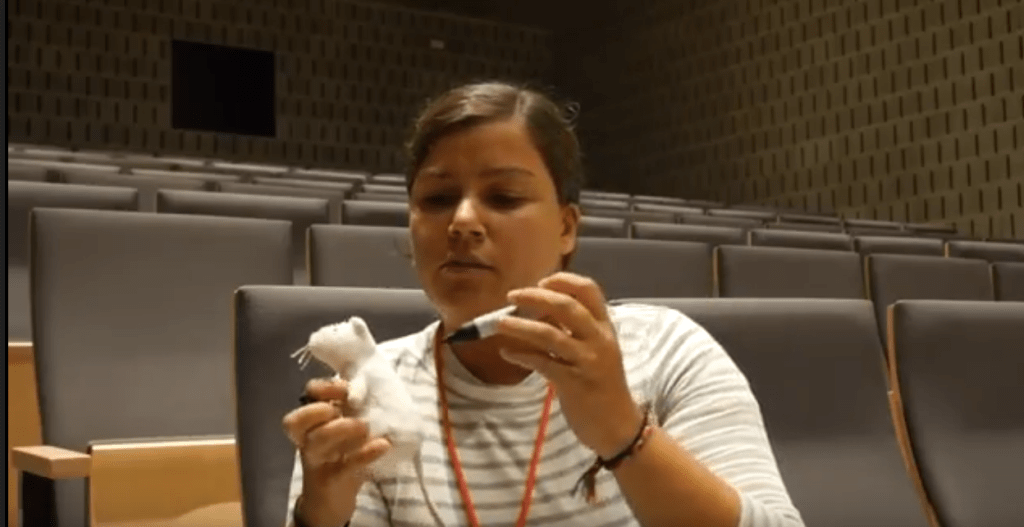
Why are we recording a video of my colleague Rita Santos painting the back of a white IKEA mouse with a black marker pen?

The background story is that nearly 50 years ago, in 1974, a US researcher painted real laboratory mice as part of what has become a well known story of scientific misconduct in biomedical research. The story isn’t as well-known among biologists and animal scientists as it is among immunologists (or at least so I assume, based on anecdotal evidence = whom among my contacts and colleagues who were or were not aware of it when I asked), despite being both striking and somewhat sad.

Striking, because once you’ve heard the story, you are likely to remember it. Dr William T Summerlin was doing research into transplantation immunology. He believed that by keeping the tissue in laboratory culture for some time before transplanting it into the recipient animal, it could be transplanted without rejection. His proof-of-concept experiment was to graft skin from black mice to (genetically unrelated) white mice. Did he actually ever transplant skin? I don’t know – this amount of detail is not given in the easily accessible internet sources. But what is very clear is that his demonstration of success was a fraud. An attentive technician discovered that the black patch on the back of the white mouse could be rubbed off with ethanol. As reported in this NY Times account of the case, published only a month later, Summerlin admitted to having painted the mice.

Sad, for a number of reasons, going beyond the actual misconduct itself, which is of course in itself highly lamentable. The painted mice seems not to be a one-off event – when Summerlin was investigated the committee also discovered a seemingly very dubious case of cornea transplant experiments in rabbits. Whereas having their backs painted would hardly have harmed the mice, the failed cornea transplants must have caused the rabbits pain. And none of this was justified. Scientific experimentation is not about simply trying something to see if it works: there has to be a reasonably developed idea of what mechanisms are involved. I don’t find any reference to a theory about mechanisms involved in the purported transformation of a xenograft (from a genetically different individual) into tissue that is not recognised as foreign when transplanted into a recipient. All that is to be found is that Summerlin had claimed for some years that he had a method for laboratory culture of tissues that removed the problem with transplant rejection, and that other researchers were unable to make the procedure work when they tried to repeat it in their own labs (a classic way through which fraudulent or poorly conducted research is discovered). The requirement that an experiment is based on a reasonably developed theoretical framework and previous, related studies is even stronger when the health and well-being of living beings are involved.

Why, then, are we painting mice? As part of the INTEGRITY project, we are developing teaching material into ethics and research integrity issues in animal experimentation, for high school students, ready for road testing in about a month. And please note, we’re not painting mice, we’re painting toy mice. The first R, Replacement, of the 3Rs principle of course. Knowing what mice are like, I actually believe that using real mice for this purpose would not only have been stressful for them but a pain for us!

What if the slaughterhouse came to the farmgate? Interview with Jan Hultgren about mobile slaughter.

Jan Hultgren, SLU.

Jan Hultgren, Swedish University of Agricultural Sciences, livestock transport is one of the huge challenges for animal welfare. Every day, hundreds of thousands of animals are loaded onto lorries for road transports which may last several hours.

One of the main reasons for transporting animals is to take them to slaughterhouses. A possible implication of your recent CABI Review is that we may not need to transport animals as much as we do now if we made better use of mobile slaughterhouses and on-farm slaughter. Can you tell us more about these approaches?

A major challenge is to produce food in a sustainable way with regard to environmental impact, social cohesion and economy. Sustainability requires fair trade and markets, authenticity of products and consideration for animal welfare, food and occupational safety, as well as waste management. At present, meat from livestock and poultry is severely overproduced and overconsumed in most countries where the population can afford it, which is associated with industrialized animal husbandry and slaughter, negative environmental impacts and public health issues. Unfortunately, retailers mainly compete with low prices, despite the fact that food has never before made up such a small part of consumers’ disposable income. A large number of animals are transported and slaughtered to meet the demand for cheap meat, and despite strict animal welfare legislation in many countries, conditions are often far from perfect. Time constraints for stockpersons, imperfect slaughter-plant designs and rough animal handling result in stress and poor meat quality. Due to urbanization and a change in lifestyle, the gap between producers and consumers is widening, and it is already huge in some parts of society. Many citizens do not know at all how farm animals are kept and how meat is produced, because they only see pre-packaged pieces of meat in the store. Some farmers and slaughterhouses are afraid of criticism from animal rights activists and the transparency of their activities is very limited. Many citizens may not want to know how farm animals are treated, and as a result of how production is organized, they do not even have the chance to learn. Even some farmers do not have the opportunity to see how their animals are treated during transport and slaughter, let alone to influence it. Mobile and small-scale slaughter have the potential to alleviate or solve some of these problems, thus connecting meat producers and consumers, providing access to locally produced meat, stimulating economy in rural areas and reducing the transport of live animals. But for small-scale slaughter to have a significant impact on the meat market, overconsumption will probably also have to be limited. And consumers must be willing to pay for the luxury product that meat is.

Cattle before slaughter at one of the farms under study in Sweden. Photo: Anne Larsen, Swedish University of Agricultural Sciences

What is the uptake of these technologies like, and what are the main obstacles?

Like any other business, meat production must be profitable in order to survive. There is a great public awareness of the importance of sustainability and animal welfare, which creates a demand. There is also a growing interest in relatively expensive, high-quality meat. Small-scale and low-stress slaughter can thus create added value that producers can benefit from. Nevertheless, some pioneers probably must be willing to take financial risks to develop new technologies and methods as well as good role models for a major change to take place. Today, slaughter alone does not seem to pay off. But if the meat can be marketed as an exclusive high-quality product to a limited consumer segment, it can. There are many examples of small-scale farm-based slaughterhouses for cattle, sheep and pigs that receive slaughter animals from the same farm or nearby holdings. In Sweden, many of these abattoirs have been able to start thanks to advantageously reduced fees for establishment permits and meat inspections, which may not continue. For decades, mobile slaughter of smaller species such as sheep, reindeer and poultry has been practiced in several countries. There are also examples of mobile slaughter of calves, pigs and horses, but mostly for consumption in the farm household. To market the meat, official meat control is required, which can be expensive, especially for small-scale businesses. The political interest in modernized meat inspection is great, and new technology for video-assisted remote control may prove useful, which would reduce inspection costs. Conditions vary between countries due to tradition, consumption patterns and official policies. More recently, as I described in my review, mobile slaughter of large cattle has been developed. Various types of mobile plants for large livestock have now been introduced in many countries, including the United States, Australia and parts of Europe. Some of the methods and techniques used in small-scale and mobile slaughter differ from large-scale stationary slaughter and therefore time is needed for development. The slaughter industry has a long history of development and staff training for large-scale operations, so it is no surprise that small-scale abattoirs are technically and financially challenging.

Is it possible to make an estimate about how much road transport of livestock could realistically be avoided?

Theoretically, all animals could be slaughtered on farm, in that way avoiding all transportation of live slaughter animals. This will not happen, at least not in the foreseeable future. The degree to which transportation can be avoided will of course depend on farming structures, local traditions, consumer preferences, official policies and the extent to which different slaughter methods are found to be reliable and acceptable. As I described in my review, Swedish researchers have estimated that mobile abattoirs may decrease the number of long journeys drastically; five mobile plants would decrease the proportion of Swedish cattle transported for more than 4 hours by 78%, and the proportion of Swedish pigs by 91%. However, these researchers have also shown that new small-scale abattoirs cannot be expected to shorten driving distances or improve animal welfare unless the plants are located strategically. In regions with very small and sparsely located farms, mobile slaughter is less viable. In 2017, a Swedish mobile abattoir slaughtered 4630 large cattle or 1.2% of the Swedish commercial cattle slaughter, operating all over the country. The following year it went out of business due to poor profitability. Many of the methods that together can be termed small-scale slaughter are not always applicable and they will not likely replace industrialized slaughter completely. But they can still mean a lot to many animals and the rural community. It is not only a question of avoiding road transports.

Replacing the use of animals in research

How can we change the current thought culture of the research community in regards to animal use in basic research? The question was asked by Kathrin Herrman in this online conference that I’m attending today.

With 20 years experience of working with animal welfare and 3Rs research in a biomedical research institute, I certainly have thoughts around that question. For transparency, the evidence base for this is only my own experience; I haven’t systematically collected data.


A challenge when tackling the question is that we don’t know a lot about how researchers actually think about the use of animals versus non-animal replacement alternatives as research models. But if we think about the research community and its practice as a reflection of collective and individual thinking, there certainly is a rather large acceptance of the use of animals. That doesn’t mean that researchers wish to use animals, it means that at least in their current context they understand that it is sometimes the best way.

Legislation is definitely not going to change this. We have very good legislation regulating animal use in research in Europe, but however much that legislation includes the aim of total replacement of animal research with non-animal methods, it is not (and should probably not be) designed to lead to that replacement. The legislative mechanism for what kind of research will be allowed is the review process for licensing experiments. In this process, researchers present their project plan to an ethics committee (or something similar, the names vary between countries). The review can lead to many changes of the project, but the choice of research method isn’t really something an ethics committee can influence much. Only people who are real experts on the research in question can in an authoritative way challenge the choice of methods, and the discussion in an ethics committee which has to evaluate projects from a wide range of topics can’t be on that level.

But there can be other types of “external” influence on researchers’ choice. The currencies in research are successful funding applications and published papers. So decisions that affect funding attribution and publication acceptance will be highly influential. The challenge in influencing culture that way is that funding and publication decisions are still made by scientists – so it is still about changing how scientists think.

My own personal belief is that the change from animal to non-animal methods come through a combination of concerns about the use of animals (which many scientists have; they are after all often the ones who have to carry out the experiments) and availability of non-animal models which are actually better than animal models. The current development of organoids and advanced 3D models is very interesting from this perspective.

The overall research infrastructure is also important. Funding and publication decisions are part of that, but also the support structure that exist in the immediate environment. If I think about my own organisation, we provide excellent support for people who plan to use animals (and we are legally required to do that, people need to have training to get a license, the animal house need to be licensed and have enough personnel etc). We need to provide the same amount of support for people who want to use advanced non-animal models.

And in most research institutions that is far from where we are today.