“The business of animal suffering and death”

Last weekend I received the following e-mail:

The website of Lab-Animal-Training offers courses that train people to “carry out procedures on animals” and to “kill animals,” activities referred to on your website as “EU Function A” and “EU Function D.”

You call this “laboratory animal science,” but it is, in reality, the business of animal suffering and death. You profit from training people to ignore the most basic ethical principles.

The e-mail was sent to a number of recipients. For some reason, I and a colleague in Switzerland were singled out as individuals among a list of mainly organisations. Given the content, I assume that we were all chosen as having a role in training scientists for doing experiments with animals. The functions referred to are the ones of Article 34 in Directive 2010/63/EU which is the legislation regulating the use of animals in research in the EU, and one of the many things the Directive covers is the requirement for training before doing any work that involves animals.

I totally understand that it is disturbing that there are training courses with the focus on killing animals, in particular when it is as explicit as the Directive is about that this is precisely what it is. I appreciate that the Directive is not using euphemisms here; we all need to be aware of that what we are doing when we are ending the life of an animal is to kill it. And it doesn’t qualify for the term euthanasia unless it would be in the animal’s own interest and this is only the case for terminally ill animals for which nothing else can be done.

But there is a weird assumption of cause and effect. People are not doing experiments on animals because they have taken our courses – they take our courses because they are doing experiments on animals and therefore need the training our courses provide. It is not as if we’re luring people into doing experiments on animals by organizing training courses.

Are we teaching people to ignore the most basic ethical principles? It seems easy to assume that not to kill and not to do harm is one of the most basic ethical principles, and I respect people who decide to live fully according to that idea. It of course means not to consume products of animal origins, and for consistency many also argue that it must mean not to use any medical treatment that has been developed using animals. It is very obvious that society in general, in most places of the world, is not based on an ethical principle of not killing and not harming any living being.

What we do teach is how to do experiments on animals causing the least possible harm and suffering to them. This is what I call the compromise position, the one that legislation is based on and therefore somehow the official position in our society, the European Union.

The profit, then? Whether you call it surplus or profit, when income is greater than expenditure, you have money left after paying all the expenses, and you can do things with that money. For not-for-profit organizations, which is the category in which most course organizers are found, this money is used for other important activities within the organization. In our case for research, since that is our “core business”.

Thanks to the funds generated through training courses in laboratory animal science, we are able to invest in research that we believe in without having to wait for successful funding applications. So far, we have been able to fund a one-year fellowship for a young animal welfare scientist to do research into the welfare of shelter dogs that are being trained by prison inmates.

Mice developing human cells – challenging how we think about ourselves or about animals?

This blog has been dormant for four years, and I don’t know if this will be a single post or actually represents a first step in attempting to re-establish a writing practice beyond papers and reviews and grant applications again. Time is an issue – not least because ideally I would like to research the topics I write about more than I have done this time. On the other hand, I’m hopeful that I’m on my way to recover some of my time and also inspiration, and arguably I also have more experience to fall back on wi

Two headlines in this week’s mail alert from Nature have inspired the heading.  Both have to do with animal embryos developing with human cells incorporated into their bodies. Japanese researchers have been successful in achieving this by injecting the cells directly into the amniotic fluid of pregnant mice, whereas a Chinese team reports growing hearts containing human cells in pig embryos. The Japanese project seems to be more of a technology breakthrough – if that term is even justified for what is perhaps better described as a successful attempt to do something the researchers themselves didn’t really expect to work:

The team used reprogrammed stem cells to grow human organoids of the gut, liver and brain in a dish. Shen says the researchers then injected the organoids into the amniotic fluid of female mice carrying early-stage embryos. “We didn’t even break the embryonic wall” to introduce the cells to the embryos, says Shen. The female mice carried the embryos to term.

“It’s a crazy experiment; I didn’t expect anything,” says Shen.

Within days of being injected into the mouse amniotic fluid, the human cells begin to infiltrate the growing embryos and multiply, but only in the organ they belonged to: gut organoids in the intestines; liver organoids in the liver; and cerebral organoids in the cortex region of the brain. One month after the mouse pups were born, the researchers found that roughly 10% of them contained human cells in their intestines — making up about 1% of intestinal cells

Of course, we should keep in mind that none of the studies have yet been peer reviewed and published. We don’t know the quality of the studies or whether the results can be replicated. But making animals that produce human cells has been a big goal for many researchers for decades, and I don’t see any reason why technology would not continue to develop in that direction. This is not to say that I don’t think this is an unquestionable given, but so far this research is ethically and legally possible in enough countries where there are also resources to develop it. And the technology hurdles are probably gradually being overcome – although as we will see below not everyone is convinced that this is happening any time soon.

Which, then, are the consequences seen from the perspective of my own area of research, animal ethics and the 3Rs of animal research?

In terms of the general ethics of how humans treat other animals, this represents another way in which humans use animals for their own benefit. Whether or not we agree with this widespread human attitude (and there’s a lot to be said about the ethical aspects of it!), for the animals the practice described here is not radically different from other ways they are handled in research and technology. Non-human animals are unlikely to suffer from the concept of being used; what matters is probably what they experience as a consequence of what is done to them – largely what we cover in considerations of the 3rd R of Refinement. Since the studies haven’t been published, how exactly the animals were handled is not known outside the research team itself, but the most affected animals are probably the females carrying the embryos, and that as a consequence of the procedures done to them rather than related to the nature of the embryos.  

The 2nd R – Reduction (of animal number) is where this kind of research really has consequences. On the one hand, given that the aim is to have liveborn animals with human tissue (for research or for transplantation), the use of animals is required (in other words, no possibility for Replacement, the first of the 3Rs). On the other hand, this is the kind of research that when successful may lead to an increasing use of animals. The possibility to do research on animals that have organs based on human cells is attractive for biomedical research as a way to overcome the biological differences between species, which then may increase the demand for research animals. In a paper entitled The 3Rs Alone Will Not Reduce Total Animal Experimentation Numbers: A Fundamental Misunderstanding in Need of Correction, philosopher Nico Müller at the University of Basel develops this argument:

The basic problem is that innovation occurs not just in NAMs, but also in animal methods. The assumption that NAMs innovation will in time lead to lower total distress discounts innovation at the other end of the spectrum, that of new distress-inducing animal methods. But of course, innovation in this area is constantly blooming, as every new animal experiment is also a methodological innovation. What is more, these innovations may often conform better to established paradigms and face fewer obstacles than innovative NAMs (Lohse 2021). A stark example of a breakthrough innovation in animal experimentation can be seen in the advent of genetically modified research animals, which led to a significant increase in total animal experimentation numbers worldwide (Ormandy, Schuppli, and Weary 2009). Actual conditions aside, in principle, for every distress-inducing technique replaced, reduced, or refined, two new ones can be invented, such that total distress increases despite the steady progress of the 3Rs. On the whole, the 3Rs can diminish total distress only under conditions that, by coincidence or by design, hinder the innovation and proliferation of new distress-inducing methods. But the 3Rs cannot ensure that such conditions obtain.

https://www.theguardian.com/science/2021/may/15/mixed-messages-is-research-into-human-animal-hybrids-ethical-chimera

Regarding the challenge to how we think about ourselves, I was about to say that this is a question that goes outside my own area of research. But that isn’t entirely true, in that we did discuss the question of species barriers in a series of interviews done by then PhD student Pedro Ramos and published two years ago in New Genetics and Society. We interviewed scientists working with gene editing, and their view of the issue is very similar to that of the scientists that spoke to The Guardian around the same time about chimeras:

Nakauchi, now at Stanford University in California, says that the ethics of such experiments are most fraught if they generate “ambiguous animals, such as a pig with a human face or human brain”. That might be impossible even in principle, given the evolutionary distance between pigs and humans – but for monkeys it’s less clear. So we should avoid making human-animal chimeras with a large human component, he says – and perhaps use genetically modified human stem cells that can’t make brain cells. Wu agrees, but stresses that they never intended to implant any of their chimeric embryos for further growth anyway – the aim is not to grow human organs in monkeys. He doesn’t think that should be contemplated if we don’t know where the human cells might end up. “What matters to me is where the human cells go and how many there are,” says biologist Marta Shahbazi, who works on embryo development at the University of Cambridge. “If we confine them exclusively to an organ of interest, like a pancreas, that’s OK: a mouse with a pancreas made of human cells is in no meaningful sense ‘human’. But for a mouse with human stem cells spread throughout all the tissues, the answer is not so clear. And for a monkey, things get even more blurry.”

What these scientists are speaking about is what philosopher Bernard Rollin describes as telos. As long as the pigness of the pig is not overrun by human characteristics that we prefer confined to the humanness of the human, things are fine. Of course, where to draw that line is not an easy task. Other scientists, however, have a different perspective altogether on whether this is something we need to discuss at all.

Alfonso Martinez Arias, a developmental biologist at Pompeu Fabra University in Barcelona thinks the claims of Izpisua Belmonte and colleagues are completely overblown anyway. He thinks all they have really shown is that when some human cells are added to monkey embryos, they become moribund. “If you add some extraneous cells that make it more difficult for the embryo to survive, what have you learned from what is a rather sick biological entity?” he asks.

“Human-monkey chimeras are not coming soon, and may never come,” he says. “In any case, we don’t need them – not to answer biological questions, nor to solve problems associated with organ donors.”

Being open about animal research

Today is Being Open about Animal Research Day, #BOARD21. If I can pretend to speak on behalf of my institution, this is what I would say about us. This is what I’m trying to act in line with.

We do research with animals. We also develop non-animal models for biomedical research. Transparency means talking about both, in a way that is as unbiased and as honest as possible.

I’m not a typical researcher using animal models, and my way of being open about animal research will be particular for my own professional self and context.

I’m an animal welfare scientist in a biomedical research institution, i3s – Instituto de Investigação e Inovação em Saúde. I have worked in this organization for 20 years, I have learned a lot, unlearned some, and hopefully achieved one thing or another in terms of institutional culture, practice and infrastructure.

My greatest passion in the field is the research we develop to improve animal welfare, and in particular our research into survival of laboratory mouse pups. This is the topic I have worked on for the longest time, and it has brought fantastic collaborations with great colleagues and outstanding research institutions. At the point where we are now, I’m also believing our research finding can bring about change.

But changing the world through research is a very slow process. Training is much more impactful – or at least so I hope, since this is the other main part of my work. My institution has hosted a training course in laboratory animal science for researchers working with animals since 2005. It makes a huge difference for the mindset and for the standard that everyone who works with animals has been extensively trained to do so. It helps to create a spiral effect where knowledgeable researchers demand high quality support from the animal facility – and the animal facility can set high standards for how animals are treated in research. For us, adhering to international accreditation schemes – FELASA for our training course, AAALAC-International for the animal care and use program as a whole – has been crucial to keep up the quality and to improve.

Institutional measures to promote quality in research with animals are important. The same is true for quality in animal care. Working with international accreditation schemes (FELASA, AAALAC) help us to keep up the quality and improve.

But there is a lot more we can do.

I would like to know that all researchers when planning their research think carefully about what the right model is to address their research questions. And that they get support in this – that they are challenged to think, that they have experts to “think together” with, and that they get expert support in implementing the models. This should be the case for both animal and non-animal models.

I have a vision for how to achieve this within my own institution. To get the entire research community to think this way is beyond my reach, but of course it’s an important ideal.

In the meantime, I wish for all of us to be honest about what we do and what we can achieve. There are problems in practice with animal model research and problems with non-animal model research. We should work to prevent and overcome these problems, and not deny that they exist, or act as if they only happen in one type of research. There are limitations of animal models and limitations of non-animal models. If we speak about the limitations of one, we should also speak about the limitations of the other. Selective use of facts is not good practice in science communication. But it’s far too common in the discussion of animal experimentation – on both sides of the debate.

Survey to assess requests for evidence on animals – or research with an agenda?

A Survey to Assess Journal and Reviewer Requests for Evidence in Animals is doing the rounds in the research community around Replacement of animal research. This survey addresses an important question in the discussion of how the research community self-regulates (or not) the use of animals in research. Colleagues who study biological mechanisms such as gene regulation or the role of a given molecule in a certain context have repeatedly commented that trying to publish a paper with only work done in non-animal or at least non-vertebrate systems is often met with requests for experiments in animals. People who are not normally using animals in their research are driven to do so to meet these requests and get their work published in the desired journal. Of course, such anecdotal evidence is only relevant to point out that there is an issue to investigate. We do indeed need systematic research to understand how often it happens, in which contexts and to what extent this phenomenon actually drives the use of animals in research.

But is the present survey a credible systematic research effort? Unfortunately, I find two serious reasons to question that Physicians Committee for Responsible Medicine is a credibly author of research into drivers for the use of laboratory animals.

Before I develop my reasoning further, I need to make a reservation. I know – because I just did so! – that if you google “Physicians Committee for Responsible Medicine Criticism” you will find harsh statements against the NGO. I’m not echoing this criticism here, in particular because it comes from sources which are in themselves just as questionable or perhaps even more so.

But PCRM is an advocacy organisation, with an agenda:

Would you trust a study into the impact of meat consumption run by an entity whose mission was to promote beef or pork? I wouldn’t. I apply the same skepticism when it comes to studies run by entities with the opposite agenda. PCRM lobbies against the use of animals in research. Which is a perfectly valid mission for an advocacy organisation. But research and advocacy are not easy bedfellows. And that’s my first reason not to think PCRM is the right entity to run this survey.

To develop my second reason, I will put my peer reviewer hat on. As a senior researcher, I serve or have served on panels which assess applications for research funding for publicly funded research councils in several European countries. Any given call that opens will get many more applications than its budget allows it to fund, and it is important that the proposals are assessed by experts to make sure that the public money is spent on research projects which can be expected to deliver reliable research results. One of the critical questions any reviewer of a project proposal will ask is: Does this team have the relevant expertise and experience to carry out the proposed research? Previous publications by the research team presents the most important proof that they have enough experience and expertise in the field to be trusted with money for a research project.

Assessed on basis of the publications they present, PCRM wouldn’t score high in a funding review. This is what we find under “Our research”: one paper on diabetic neuropathy, six papers on diabetes, seven papers on diet interventions, and 30 “reviews, editorials and additional research”, all on nutrition. Not a single paper on research models, and as far as I can see not a single paper using survey methodology. Would a research council entrust this team public money to use survey methodology to investigate issues affecting model choice? I don’t think so.

Having said all the above, one thing would make me reassess my skepticism: preregistration of the study. No researcher is completely neutral and any researcher is prone to wishful interpretation and even to analysis methods that supports such interpretations. That’s why the concept of preregistration was born. By declaring up front what a study aims to do and which methods it will use, researchers are prevented from ‘sliding’ interpretations of the kind that worry me here. If PCRM had preregistered their study, with a clear declaration of the research aim, the method for data collection and the planned analysis, I would be much less worried. Both because I would know that the authors would be committed to their registered approach, and if the registration was public I could also assess the quality myself.

Unfortunately, I don’t think they have (but I would be happy to stand corrected!) and therefore I’m not taking the survey. But we need the research.

Painting mice

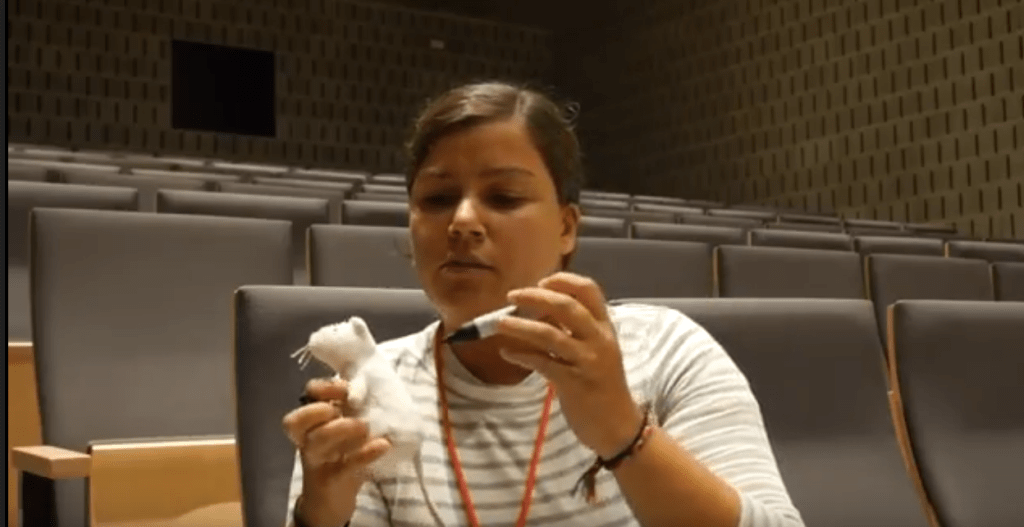
Why are we recording a video of my colleague Rita Santos painting the back of a white IKEA mouse with a black marker pen?

The background story is that nearly 50 years ago, in 1974, a US researcher painted real laboratory mice as part of what has become a well known story of scientific misconduct in biomedical research. The story isn’t as well-known among biologists and animal scientists as it is among immunologists (or at least so I assume, based on anecdotal evidence = whom among my contacts and colleagues who were or were not aware of it when I asked), despite being both striking and somewhat sad.

Striking, because once you’ve heard the story, you are likely to remember it. Dr William T Summerlin was doing research into transplantation immunology. He believed that by keeping the tissue in laboratory culture for some time before transplanting it into the recipient animal, it could be transplanted without rejection. His proof-of-concept experiment was to graft skin from black mice to (genetically unrelated) white mice. Did he actually ever transplant skin? I don’t know – this amount of detail is not given in the easily accessible internet sources. But what is very clear is that his demonstration of success was a fraud. An attentive technician discovered that the black patch on the back of the white mouse could be rubbed off with ethanol. As reported in this NY Times account of the case, published only a month later, Summerlin admitted to having painted the mice.

Sad, for a number of reasons, going beyond the actual misconduct itself, which is of course in itself highly lamentable. The painted mice seems not to be a one-off event – when Summerlin was investigated the committee also discovered a seemingly very dubious case of cornea transplant experiments in rabbits. Whereas having their backs painted would hardly have harmed the mice, the failed cornea transplants must have caused the rabbits pain. And none of this was justified. Scientific experimentation is not about simply trying something to see if it works: there has to be a reasonably developed idea of what mechanisms are involved. I don’t find any reference to a theory about mechanisms involved in the purported transformation of a xenograft (from a genetically different individual) into tissue that is not recognised as foreign when transplanted into a recipient. All that is to be found is that Summerlin had claimed for some years that he had a method for laboratory culture of tissues that removed the problem with transplant rejection, and that other researchers were unable to make the procedure work when they tried to repeat it in their own labs (a classic way through which fraudulent or poorly conducted research is discovered). The requirement that an experiment is based on a reasonably developed theoretical framework and previous, related studies is even stronger when the health and well-being of living beings are involved.

Why, then, are we painting mice? As part of the INTEGRITY project, we are developing teaching material into ethics and research integrity issues in animal experimentation, for high school students, ready for road testing in about a month. And please note, we’re not painting mice, we’re painting toy mice. The first R, Replacement, of the 3Rs principle of course. Knowing what mice are like, I actually believe that using real mice for this purpose would not only have been stressful for them but a pain for us!

Reading to update my teaching

Opening a Twitter account has consequences. I’m carefully keeping to scholarly activities, and so the main side effect for me has been an ever expanding list of interesting papers I really need to read. This is mainly a good thing: as a senior researcher and group leader I certainly don’t read enough new papers simply because they are interesting and relevant (as opposed to: because I need to do something with them as I’m either a co-author of, editor for or reviewer of them).

It’s nearly August and I teach in September. My reading list for now is about what I would like to read and think about to update my teaching:

The challenge for me is to find the right balance in helping students to do what they can where they are as researchers using animals, and challenging them to find ways of doing better. Unless I challenge myself, I easily settle too much on the status-quo side!

There’s also Heather Browning’s very recent PhD thesis If I could talk to animals: Measuring subjective welfare, of which I’m very interested in the second part which addresses measuring welfare from a philosophy-of-science perspective. And I want to take Daniel Lakens’ Coursera courses Improving your statistical questions / Improving your statistical interferences.

And then there are a couple of books on my desk…


Human-Animal Studies in Portugal: Interview with Verónica Policarpo

Verónica Policarpo, you are coordinating a new postgraduate course at the University of Lisbon, Animais e Sociedade (Animals and Society). Tell us more about this course!

20191008_141900

The course Animais e Sociedade is part of the activities in the context of the Human-Animal Studies Hub. In late 2018, my research institution ICS-ULisboa submitted an application to the US-based International Development Fund do Animals and Society Institute, to bring Human-Animal Studies to Portugal. In this application, we proposed a number of initiatives to launch the basis for this discipline in Portugal, in order to ensure a stepwise and sustainable development of the field. This postgraduate study program is one such initiative. In fact, this type of initiative is what the development fund is for: to promote the implementation of courses in countries where there is little or no activity in the field of human-animal studies. In February 2019, our proposal was awarded funding, which allowed us to continue existing activities as well as launch new ones, such as this course.

What is the unique objective of this course? To provide a scientific, pluralistic and interdisciplinary perspective on the relationship between human and non-human animals, from the viewpoint of the Human-Animal Studies field, and in Portuguese. The course brings together a broad and diverse set of themes, to suit the training needs of students from different professional and disciplinary backgrounds. The program includes themes as diverse as companion animals and multi-species families, the relation between children and animals, the situation of animals in disasters, questions related to wildlife conservation, animals for food production, the welfare of animals used for entertainment and kept in captivity, animal rights and animal politics, media representation of animals as well as the questions of animal law under discussion in Portugal right now. Teachers and specialists from different disciplinary fields will contribute: sociology, anthropology, psychology, philosophy, biology, veterinary medicine and law. The aim is to stimulate critical thinking about human animal relations, based on state-of-the-art scientific information from a variety of fields of knowledge.

The course is part of the initiative you coordinate in establishing this new field of study in Portugal. Tell us more about the field internationally!

Human-Animal Studies is an interdisciplinary field of study. It started to develop in the 1980s, in the USA, in parallel with the modern animal rights movement, following the publication in 1975 of Peter Singer’s Animal Liberation and in 1983 of Tom Regan’s The Case for Animal Rights. This first phase is characterized by philosophy coming back to the question of the value of animals, a question raised by philosophers such as Jeremy Bentham in the 18th century – changing the focus from the capacity of animals to think to their capacity to suffer. At the same time, the social sciences were producing emprical evidence of the extraordinarily diverse and complex relations that develop between humans and animals, with focus on the human benefits. Focus was on companion animals and primarily using quantitative methods. In response to this movement, the more interpretative social sciences and the humanities (fields such as history, literary studies and cultural studies) explored the cultural aspects of the framework in which these relations develop. This includes studies of how animals are represented in literature, art and media, or how human-animal relations have changed over time in a historic perspective.

In the 1990s, the second development phase of Human-Animal Studies widened the scope to include all types of human-animal relations: past or present, physical as well as virtua co-existence, harmonious and beneficial relations as well as those characterized by conflicts and risks to one or several of the species involved. Qualitative methods became more common, and geography, especially human geography, emerged as an important field. In disciplines such as psychology, emphasis is on the human-animal bond. In the humanities, the focus is on deconstructing what it is to be an animal, and in the attempt to understand what animals are. In this phase, important input also comes from gender and feminist studies, looking at correlations between different groups that have been oppressed historically: women, ethnic minorities, animals. Criticism of the patriarchy and the notion of intersectionality become important.

Starting around 2000 the field of study virtually explode in what can be described as the third wave. In North America and the UK, courses or university program multiply. From the field of anthropology, innovative ethnographic perspectives emerge, in which animals are integrated as research subjects in multispecies ethnographies. A parallel development are the Critical Animal Studies, a current which brings together academic research with an activist agenda of animal liberation. The academic publishing is thriving and in 2012 the main journal in the field is established:  Animals & Society. In 2014 the International Development Fund of the Animals and Society Institute is established, providing support for courses and training programs in countries where there is no tradition of Human-Animal Studies.

In Portugal there is much less research and far fewer researchers dedicated to the study of human-animal relations, compared to the vibrant international production. Nevertheless, during the last decade there has been some work, although not under a common framework. The Human-Animal Studies Hub aims to be that framework, bringing together under the same “intellectual ceiling” researchers from different fields with a common interest in animals and the human-animal relationship.

The Hub is organized along three axes: research, training and society outreach. I invite all researches with activity in this field to visit our web page and read our Mission, Values and Vision. If you identify with these, you are encouraged to contact us. The objective is to establish a network of synergies, creating a space for dialogue and collaboraiton. At the moment, the Hub hosts projects about companion animals, animals in disasters, feral and abandoned animals and production animals. There are several training activities, including a biannual International Summer School, a monthly reading group and this recently established postgraduate course. We also organize workshops, conferences and seminars.  grupo de leitura mensal, ou este recentíssimo curso pós-graduado Animais e Sociedade.

CARTAZ-POS-GRADUACAO-A&S-A4

Outside the academic context, for whom is this course relevant? In which walks of life do we need more knowledge about animals and society?

We definitely need to produce, and to share, more knowledge about how we live together with animals in society. In my view, everyone who works with and for animals in society need more training: ONGs, animal shelters and other organizations. Training needs to be available for professionals who deals with complex human problems such as poverty, unemployment, separations and physical and mental disease. Social assistants, psychologists, lawyers, educators, teachers. These problems have a human origin but they affect human and animal lives. And also complementary training for professionals who work directly with animals but whose education has not included a comprehensive view of the social problems around human-animal relations, such as biologists and veterinarians.

Find out more by following Verónica Policarpo @VMPolicarpo and Human-Animal Studies Hub @humananimalics on Twitter.

Veterinarians’ and physicians’ attitude to euthanasia

The most recent contribution from the Ordem dos Médicos, the Portuguese professional organization for physicians, to the ongoing political discussion of legalizing euthanasia was to state that they would in no way engage with the process. Of course, the discussion of euthanasia in human medicine is beyond the scope of this blog, and Animalogues is not the right place to share my personal thoughts about something that is not part of my professional consideration.

But I will take the opportunity to share a paper that I find highly relevant in the context.

Untitled

This paper, published in Journal of Medical Ethics in 2010, reports the results of a questionnaire to Swedish veterinary surgeons in 2008. It’s part of a larger body of work on attitudes to physician-assisted suicide by two of the co-authors, Lindblad and Lynöe, which also includes surveys to physicians and to the general public in Sweden.

Why would medical ethicists be interested in what veterinarians think about physician-assisted suicide in human medicine? This interest has to do with the argument sometimes presented by physicians that “less experienced physicians and the general public do not know what they are actually reasoning about when dealing with end of life issues”. But unlike medical doctors in Sweden, where euthanasia is illegal, vets regularly perform active euthanasia as part of their professional practice. Hence it can be argued that a veterinarian, at least to some extent, knows more about euthanasia than a physician.

Untitled

Perhaps unexpectedly, it turned out that veterinarians’ attitude to physician-assisted suicide is comparable to that of the general public rather than that of physicians.

The authors conclude that “Similar to the general public, most Swedish veterinary surgeons are in favour of PAS. Since veterinary surgeons have long experience of performing euthanasia in animals it seems difficult to assert that they do not understand what it means to provide PAS at the request of a terminally ill and competent patient. Accordingly, it is difficult to maintain that knowledge about PAS and euthanasia is unambiguously associated with a restrictive attitude towards these measures”.

Is a positive attitude to animal research desirable?

The question is motivated by a recently published research paper in JALAAS: Attitudes Toward Animal Research Among Medical Students in the United States by David Q Beversdorf and Nellie R Adams.

The authors recruited student members of the American Academy of Neurology to fill in a questionnaire. 168 students completed the questionnaire, expressing their agreement or disagreement with a set of 14 positively- or negatively-biased statements regarding animal research. After that, they were given the opportunity to watch a video about animal research, and asked to fill in the same questionnaire again, which 108 students did. In the text box to the right, you can see examples of the statements the students were presented with.

Untitled

After having watched the video, the students were slightly more positive towards research with animals: the score went from an average of 4.0 to an average of 4.1. (A score near 5 shows a positive attitude to animal research, a score near 1 a negative attitude).

The authors do not make much out of that change (not surprisingly, it’s so small that it doesn’t really matter) but instead discuss the observation that “a substantial number of
medical students express disagreement with statements that
describe essential components of the drug and procedure
development pipeline. As described above, 13.2% disagreed
with the statement ‘New surgical procedures should be tested
on animals before they are used on people,’ and 7.2% disagreed
with ‘New drugs should be tested on animals before
they are used on people.’” They continue to conclude that “The changes in attitudes after observing the video suggests that negative attitudes can be changed, and that medical education may have a role in this setting.” If you want to read the full paper, you can request a copy from the authors at ResearchGate.

Numerous studies with bigger samples and more comprehensive approaches have measured the attitude of different publics to animal research, but the present study is novel in the choice of a very specific public: medical students. My main issue with how the study was conducted is the quite one-sided study design. The video in question is produced by Americans for Medical Progress, an advocacy organisation for biomedical research and in particular the use of animals in such research. While I think the video is quite reasonable, it definitely represents a selective use of information. That’s not surprising, as the organisation behind it is working in favour of public support for biomedical researh with animals.

Should a goal for medical education be to make students more positive to the use of animals in research? I’m really not convinced that this should be a priority. I think it’s crucial that medical students get a reasonable understanding of the role of animals in biomedical research and drug development. But that also includes an understanding of critical challenges to how useful such research is. And an understanding of why the issue is contentious.

There is no equivalent video advocating in a comparable way for the replacement of animals in biomedical research. People such as the authors behind the book Animal Experimentation: Working Towards a Paradigm Change would probably be able to produce one, and it would be as credible (reasonably so) and balanced (not very) as the AMP video.

And sadly, both of them would miss out on the most critical issue in animal-based biomedical research today: how to design studies so that the results are reliable and translate to humans.

Should research ethics protect non-human primates as children?

I’ve played with the idea of writing about why chimpanzees are not more protected than children. But whenever I start to develop the argument it seems absurd – anyone who knows what laboratory animal research regulation looks like knows that chimpanzees are not more protected than children! Except that I regularly come across people who argue that in Europe chimpanzees are more protected than children.

I understand where the argument comes from: there is a single regulatory framework for research with animals in Europe (Directive 2010/63/EU) but not for research involving children. Now, this doesn’t mean that there are no rules for children’s participation in research, it only means that the rules differ between countries. And as far as I know, none of these rules allows any researcher to involve a child in invasive and risky research under any condition – except perhaps if that research is likely to help the child. In contrast, a so called safeguard clause allows EU Member States to lift the general ban on the use of great apes (chimpanzees, bonobos, orangutans and gorillas) in invasive research “in relation to an unexpected outbreak of a lifethreatening or debilitating clinical condition in human beings” (Directive 2010/63/EU Article 55:2). Or in other words, facing an outbreak of Ebola in Europe, vaccine trials in chimpanzees would be permissible. (Whether this research could actually be done in practice is a different question. For a long time, the only industrialized country to keep chimpanzees for invasive research was the USA, but in 2015 the NIH announced it would no longer fund such research and lab chimps are now being retired into sanctuaries).

Interestingly, before I got around to writing any of this, I came across this paper which proposes that research regulation should protect chimpanzees and in fact all non-human primates (NHPs) in much the same way as it protects human research subjects. The authors argue that with so many important similarities in cognitive, emotional and social capacities, it doesn’t make sense to have different ethical frameworks depending on whether a primate is human or non-human. Therefore, they argue, we should move non-human primates out of the utilitarian framework that is generally applied to animal research ethics and into the deontological framework that applies to human research subjects. In practice, this means that research with non-human primates should respect the principles of beneficence and non-malevolence, or in other words, research should preferably benefit and definitely not harm the research subjects.

The paper is an interesting contribution to the debate and well worth reading, for the ideas and the examples of research that would be acceptable under a deontological framework. The idea that some animals should be given a rights-based protection is not new (it underlies the entire animal rights movement), but the paper contributes a unique discussion of the potential to do biomedical research with NHPs in a way that is compatible with the principles of benevolence, non-maleficience and even autonomy and justice. Unfortunately, I don’t think that the picture they paint is realistic. What can be achieved by studying naturally occurring situations is strongly limited, and I would have appreciated if the authors had been more thorough in their analysis of  what research would be made impossible if changing the ethical framework. On the other hand, if this were a paper about how to protect children in research, nobody would dream of arguing about the important research benefits to be lost if children couldn’t be harmed in research! This observation in itself clearly marks the difference in thinking about research in utilitarian and consequentialist terms versus in deontological terms.

From a pragmatic perspective, taking into account the diversity of opinion on the matter, I don’t foresee a change of framework any time soon for non-human primates in research at large. A change for the great apes is way more likely to happen in the near future. With the phasing out of invasive research in chimpanzees, the only great ape species which really played a role in biomedical research, a full ban may be accepted without much protest. By then, it may be reasonable to ask if chimpanzees enjoy greater protection than children in biomedical research. .