Cultural differences of ethological relevance

(There was dancing at the congress dinner. That’s an unwritten ISAE rule and something I fully support. But it left less time for writing, so this morning I will present a shorter reflection rather than a full resume of the 3rd conference day)

This post is not about how applied ethologists differ depending on where they come from or where they work. They don’t, actually, or at least not much, not in a significant way that I have been able to observe during my 25 years as an ISAE member. The kind of work they do may differ, because that’s in part determined by the local context in which they work. Some aspects of animal use differ indeed very little: laboratory animals are housed and used in similar ways across the world and lameness scoring is unfortunately needed for dairy cows most everywhere. But sometimes differences are huge because the way certain practices work is so different.

Yesterday presented two examples from the area of animal production. The photo below shows Victor Abreu de Lima from São Paulo, Brasil and his poster on broiler catchers and their attitudes to animal welfare.

4631A059-3258-4F08-9F55-377455351866

Catching broilers at the farm to ship them for slaughter used to be something you got anybody who needed to earn some extra money in to do. When I was a teenager, this was something a local football team could get money for a training camp doing. Obviously, having teenagers who know nothing about chickens and who just want to get out of the dark smelly dusty chicken house as quickly as possible isn’t great for animal welfare, This is at least one of the drivers for replacing manual catching with automatic. But in Brazil the development has gone the other way, and catchers are now professionals who – at least in the case of the company Victor and his colleagues work with – have a proper work contract and are trained in how to perform their task. And as you can see from the poster, they know and have a lot to say about the welfare of broilers on the farm and during catching. Whether it’s better for a chicken to be caught by a machine or by a professional handler has not been studied, but it seems quite obvious that professional handlers with this kind of insight makes for better animal welfare than unprepared occasional workers!

The next photo shows Marina von Keyserlingk from British Columbia, Canada presenting work by Jane Stojkov on whether dairy cows sent for auction are actually fit for transport. (The answer is that far too many of them aren’t). This question surprised me, as the only auctions for dairy cows I have experienced are those where a farmer sells their surplus heifers to a farmer who is expanding or improving their herd. But the auction pictured on the photo is one for culled dairy cows intended for slaughter, because that is the route between the dairy farm and the slaughter house in Canada today. And since many cows are culled because of health issues, it is a real problem for animal welfare that these cows need to go through an extra round of transport, housing and showing before they are slaughtered.

86D42E52-AE8A-45BC-AF57-241DD6A7F384

What’s the problem with this photo?

I was asked to comment on what the problem is with the stock photo above. RSPCA did well in pointing out that there is a problem, even though they somehow missed the opportunity to explain what the problem is!

The photo shows a mouse female and her litter. Based on that the pups have some fur but don’t yet have their eyes open, I would guesstimate that they are perhaps a week old. Mice are an altricious species, which means that the young are born in an undeveloped stage and are fully dependent on parental care for basically everything during their first week of life. They do develop very fast, and are ready to leave the nest at about a month of age, and sexually mature just a few weeks later. But at the stage of development in this photo, they aren’t capable of doing very much. The place for such young pups to be is the nest that their mother (or parents, males share the parental care if they can, although under laboratory conditions they may or may not be present) have prepared. That provides them with the thermal microenvironment they need – which needs to be warmer than that of an adult mouse given their poorly developed fur.

Judging from own experience of how long it takes to get a good photo of animals, by the time this photo was taken, the pups were no doubt cold. But that is only part of the problem. Anyone who has seen a professional photo session, or having had their photo taken in a studio, knows that this involves lots of bright light and reflectors. Well, this is precisely the kind of environment neuroscientists use to test anxiety in mice – an open and brightly lit space. Mice are nocturnal animals who spend their lives in tunnels and rarely venture out in the open light, and being forced to be in an environment which in nature would be dangerous is stressful for any mouse. Most likely, it is even more stressful for a female when her rather helpless pups are also exposed in this way.

If you want to learn more about our research in this field. check out the Alive Pup Project. But before you go there, let me just reflect on the different ways of making photos and for which purpose. You will see that in the Alive Pup Project we also show photos of pups taken out of their nest. But these photos were taken when the pups were weighed and inspected as part of a research project aiming to elucidate factors behind pup mortality. This is a big problem in laboratory mouse breeding, and research into the problem requires collecting data. In contrast, it is possible to make nice photos of mice in environments which are less stressful for them the one illustrated above

Still, I need to admit that we have also used stock photos of mice in unnatural environments. We simply did not think. Now we will!


School holiday animal welfare scientists

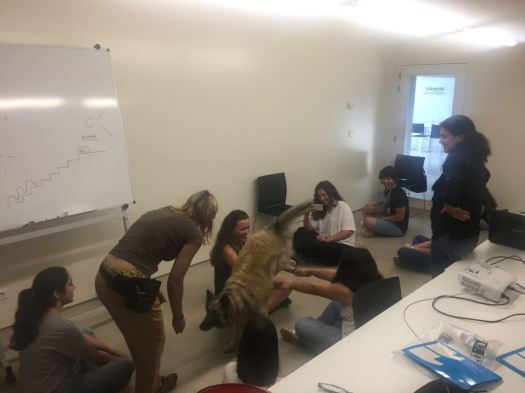
Every summer, 16 high school students participating in Universidade Júnior at the University of Porto have the opportunity to learn about animal behaviour and welfare – and practice some of their new knowledge in measuring behaviour and welfare. In the Laboratory Animal Science group at i3S – Institute for Research and Innovation in Health, we receive two groups of 8 students who spend a week each with us. Of course, we teach them a lot of theory – we’re scientists after all! – but we try to do it in as playful a way as possible. And there’s plenty of animals.

5673CE99-5461-4788-8FFD-6A9B1923692A

There are direct behaviour observations of zebrafish habitat preference, and observations from video recordings of the behaviour of mice and rats during the light and dark period.

BF3974EB-3DDE-4F7D-92A9-D28A224A91EA

There is a visit to a dairy farm, where the students perform a simplified WelfareQuality assessment and also potentially get some close-up contact with cows.

25A27A9D-BCC6-4044-81AD-B5CEF1F7A79D

E0C7BA23-AD07-4FEA-8213-367C5B22DEA0

And there is a demonstration of dog training as well as a chance to clicker train one’s colleagues.

For our research group, these are two intense but also very rewarding weeks. It is fantastic to be able to share our knowledge and passion for research into animal behaviour and welfare with 16- and 17-year olds who are as interested in animals as we are. We have been doing this since 2014, and of course we hope that some day we will meet a new colleague who once did Universidade Júnior with us!

Thanks to Sara Capas, Andreia Costa, Ana Maria Valentim and Gabriela Morello for the photos.