Why the abstract shouldn’t be abstract!

A while ago I had a brief exchange with a friend about the accessibility of research results. Not whether they are clear or understandable – simply whether somebody who’s not in an academic research institution can even get their eyes on them. Often, they can’t. because research is published in academic journals owned by publishers who want to earn money from people’s interest in reading scientific information. When this is the case, all that the common mortal can access is the abstract or summary of the paper.

There is much to be said about ways around it through Open Access publishing. But even a researcher who doesn’t consider themselves to be able to publish OA can do something to make the results accessible – and it isn’t that difficult. Use the abstract!

Here’s an illustrative example of how not to use the abstract. Of the all-in-all 10 000 words available to them, the authors used 94 for the publicly visible abstract, and not surprisingly, we don’t get to learn much about the research through these 94 words. In contrast, this example from the same journal demonstrates how 250 words is enough to clearly describe the research question, the methods and the results.

The academic carbon footprint

The Katowice Climate Change Conference just ended and I’m taking this as an opportunity to reflect on academic carbon footprints. Given how much more carbon-heavy air travel is than any other means of transport, and how limited train connections are where I’m based, my academic carbon footprint is huge, even though I do my best to minimize my personal,  I will write a couple of posts on this topic, starting with a retrospective review of my year in travelling and travel decisions.

This is rather a typical year for me since I took on two board positions in other European countries (UFAW/HSA and Swiss 3R Competence Centre). It is way more air travel than I would like. But based as I am in one corner of Europe, the only realistic alternative is not to participate. Given that I’m one of the very few animal welfare researchers in the country, this is an alternative that would impact my work negatively. I need to meet others, see their work and discuss with them. What I can do is to make the most of my flights, by combining several commitments in one. I think I’ve managed to do that reasonably well in 2018.

In January I flew to England to participate in the meeting of the Board of Trustees of UFAW and HSA in Wheathampshire. I continued to Edinburgh for a meeting about future research collaboration. I combined two trips in one, but I really could have taken the train to Edinburgh. Flying was not more expensive and theoretically faster, but I could just as well have spent the time I worked in the airport café working in the train. Direct flights Porto-London and London-Edinburgh, stopover in Brussels on the way from Edinburgh to Porto. All flights were fully occupied or almost.

In March I flew to Brussels for a week of panel meetings. Direct flight there, full. Return flight always require a stopover, the first leg from Brussels is always full, the second not necessarily so. I don’t remember if this was via Frankfurt or via Lisbon. At the panel meeting I learned about an important meeting in Paris 10 days later, to which I had direct flights, both full. In March I also decided not to travel to Utrecht for a board meeting. Instead I wrote a missive together with a colleague about how the association needs to prepare for board members participating remotely. Indeed, even though all the technology we could have was another board member’s laptop with Skype, remote participation worked well. The only real mishap was the frustration that the coffee was served right in front of the camera, whereas for me to get a coffee to my office means I had to leave the meeting for 10 minutes 😉

In April, a new PhD student started in a Marie Curie network project. He was based in Denmark before joining my group, and the kick-off meeting was going to be in Denmark mid-April, so we agreed that he would spend the first 10 days working with my collaborator in Copenhagen and then relocate after the meeting. That wasn’t my flight but it was my decision and saved one return flight Porto-Copenhagen. I flew direct Porto-Copenhagen for the meeting but arrived early and were able to fit in another meeting and spending the weekend with family. Direct flights, fully occupied.

In May I didn’t travel. I also decided not to attend the EurSAFE conference in Vienna in June which would have required a return flight with stopovers in both direction. This was a decision largely motivated by wishing to avoid travelling when I could; a colleague agreed to take over the workshop I had hoped to coordinate and for the rest, I was only going to be a spectator, so unlike all the previous trips I could really skip it without consequences for anyone else than for myself. However, an unexpected and interesting meeting in Amsterdam came up instead – but at least the flight there is direct and was fully occupied.

In July I travelled to a workshop in Lisbon by car together with a colleague, and returned by train. I did not attend the UFAW and HSA board of trustees meeting in the UK.

In the end of July I travelled to Prince Edward Island in Canada for the ISAE conference. This was a 3-legged journey and an intercontinental flight. I thought long and hard about this, but ISAE is my main learned society and the one closest to my heart and it was my last meeting as a council member. The decisive factor was the possibility to meet with a postdoc about work she is finishing for a project with me in which she was hired before she returned to Canada. Making the most out of flights doesn’t reduce the carbon footprint but it makes the harm-benefit balance more favourable.

In the end of August I had a project meeting in Berlin (direct flight, fully occupied). I continued to Sweden, again on a direct and fully occupied flight, to spend time with family. I had hoped to take the direct night train from Berlin to Malmö, which existed when I last went to Berlin in 2005, but alas, now a train connection requires several changes and costs way more than a flight. I added a meeting with collaborators in Copenhagen (train from Sweden) and then continued to Edinburgh for the AWRN thermography workshop before I returned to Porto (direct flight there, stopover in Brussels on the way back, all flights fully occupied).

In the end of September I attended the first meeting of the scientific advisory board of the newly formed Swiss 3Rs Competence Centre in Bern. Direct flights, fully occupied, train connections within Switzerland.

In October I flew to England to participate in the meeting of the Board of Trustees of UFAW and HSA in Wheathampshire. I then took the train to Cambridge for a meeting with collaborators at Babraham Institute before flying back to Porto. Direct flights both ways, fully occupied.

In the end of November I flew to Brussels to participate in a week of panel meetings. This could have been avoided; I try to only do a panel meeting a year but frankly, I had forgotten that I had already done one in March. Direct flight there, return flight with stopover in Lisbon. Flights fully occupied except the last leg, Lisbon-Porto.

In December I travelled to a meeting in the north of Spain, together with four colleagues. We convened by public transport and then continued in one car. Interestingly, during that journey I found out that one of the others always car pool to work, whereas another take his bike. (I walk, or occasionally take the metro). I’m not seeing family in Sweden for Christmas, because I will be going in the end of January for work.


What does IKEA have to do with animal welfare? Interview with Priya Motupalli

Priya Motupalli, Global Sustainable Sourcing Specialist sure is a cool title for an animal welfare scientist. Tell us what you do at IKEA Food Services AB!

Thanks!  It’s a mouthful, but it’s an incredible position where I get to place animal welfare at the heart of our vision for more sustainable agriculture.  My role is to develop and support the implementation of our sustainable sourcing strategy for the animal products in our range across all of the 52 markets we operate in.

This strategy consists of a set of programmes which covers animal welfare, environmental impact, and public health issues at the farm level.  The first of these species-specific programmes, the better chicken programme, was launched publicly in the beginning of this year.

Priya with chicken

What are the principles you apply to your work?

The mission of IKEA is to create a better everyday life for the many people.  I take this to heart in my own work—I’m not interested in good animal welfare or sustainable food production getting stuck in a niche market where only a small segment of the population benefits or has access to it.  My goal is to consistently find a place for animal welfare as a core tenant of more sustainable food systems.  This isn’t simple, as there are documented trade-offs—so I try and focus how animal welfare can connect to environmental or social issues to move the conversation forward, rather than not moving at all.

We also have something called the 7 Food Principles which set the general business direction at IKEA Food—although there is a principle around animal welfare, my favourite one is actually “food is pleasure.”  Consumers are so overloaded now with information on the dos/don’ts of sustainable consumption!  I think part of our job is to ensure that they can pick up something in the Swedish food market, or dine in the Restaurant, or grab something in the bistro and simply feel good about it, without having to panic about where it was sourced, or what the working conditions were like, or how the animals were raised, etc.  Food is such an intimate, enjoyable part of our lives—and making more sustainable or healthier choices shouldn’t be a barrier to this enjoyment!

Of course, providing this experience for our customers is a journey and there is a great saying by our founder, Ingvar Kamprad that “most things remain to be done.”

In which way does animal welfare science get into your job? Do you use actual research data or methods?

Animal welfare science is a critical part of the job—and one of the main reasons I was hired!  Current research forms the backbone of any animal welfare sourcing criteria we create.  However, as the science only tells you what you can do, not necessarily what you should do, our sourcing criteria is also a product of country specific legislation, feedback from NGOs and suppliers, and customer desires.

In addition, data collection and the use of this data to improve animal welfare over time is an integral part of our better chicken programme, and will form an integral part of our other species-specific programmes as well.  Alongside any input criteria we set, we have also identified key welfare outcomes that we will measure with the help of our suppliers and retail partners.  These welfare outcome measures will provide objective information on the quality of life for animals’ specific to our supply chain. In time, we can use this information to establish key areas of improvement and apply targeted interventions.

Our first data-set related to the better chicken programme came in recently and I’m keen to get it to start working for us!

If you are interested in how IKEA works with sustainability in general: https://www.ikea.com/gb/en/this-is-ikea/people-planet/

If you want to learn more about IKEA’s view on animal welfare: https://www.ikea.com/gb/en/doc/general-document/ikea-read-more-about-ikeas-view-on-animal-welfare__1364641255476.pdf

Follow Priya on twitter:@drpriyamots

Coverage of Better Chicken: http://5mpoultry.uberflip.com/i/976632-poultry-digital-may-2018/15?m4=

Time to think about your contribution to EurSAFE2019!

The conferences of the European Society for Food and Agricultural Ethics (EurSAFE) are among the most important arenas for the academic discussion of animal ethics. The next conference will be held in Tampere, Finland 19-21 September 2019.

These conferences have a two-stage submission procedure: first you submit a short abstract and on basis of that you are (hopefully!) invited to submit a short paper. This paper is then published in a proceedings book, which is available at the conference. As a long-time conference participant and a previous congress organizer, I have lots to say about this concept… On a positive note, it’s always an interesting book. And being responsible for editing one really made me a much more efficient editor!

In any case, this two-step procedure takes time, and therefore the deadline for submitting abstracts is well ahead of the conference. You still have a month and a half, though, this year the deadline is 2 December. More information about how to submit here.

Conference topics on animals are Animal politics, Fisheries and aquaculture ethics and Animal and veterinary ethics. Those of you who are interested in animal politics and animal law may like to know that Gary Francione and Alasdair Cochrane are confirmed as plenary speakers.

Open Science in October

Do you think about Open Science? Do you practice Open Science? Do you think Open Science matters? My research group is working on the topic during the month of October, with the aim of formulating an Open Science strategy for the group. We’re doing this because we think it makes sense for us to put Open Science into practice, but we need to work out the best way for us and our research.

We identified the following burning issues:

  • Study preregistration
  • Protocol and methods sharing
  • Data sharing
  • Preprint publication

These are the ones we are interested in but need to know more about in order to be able to practice (or make an informed decision not to practice) them. In addition, we prioritize  open access publishing and social media communication – but we’re already working on this. Although with a permanent backlog, we are uploading papers to the university open repository and we try to keep the group’s Facebook page up to date.

In a month, I hope to be able to report back on this. In the meantime, if you want to learn more about Open Science you may want to look at the FOSTER project.

Does cold stress make mothers kill their pups?

This is what a team of researchers claim in a short report published this spring in Journal of Animal Science and Technology. They base this claim on a study in which they housed female periparturient mice in different environmental temperatures (20-23C versus 10-15C) and counted pups.

Based on what I know about on mouse maternal behaviour and pup survival, a topic I have been researching for more than a decade, I don’t believe that cold stress makes females kill their pups. In fact, our research shows that females often eat their already dead pups, but rarely ever do they actively kill pups.

But if presented with convincing data, I would of course change my mind. The important thing about the short report cited in the first paragraph is that it did not present any data on maternal behaviour. The only data presented is about pups – numbers born and numbers surviving.

A few years ago, these reflections would not have left our informal research group discussions, but now there are public fora for this kind of critical discussion. So I just wrote my first PubPeer comment.

More broiler catching research

In the beginning of August, I posted about a study with Brazilian broiler catchers. One of the observations in this study was that catchers were aware that catching broilers by their legs was worse for welfare. (On the poster this is expressed as “catching by the back is better”; you can see that if you enlarge the photo).

Interestingly, this view by the catchers is confirmed by  a recently published study from Norway in which two catching methods were compared in two flocks.  Four professional catchers caught a total of 3951 birds and either caught the birds under the abdomen and carried them upright, or by the two legs carrying them upside down. Capturing under the abdomen and carrying upside down resulted in faster loading into crates, more equal and lower crate density and also tended to reduce the number of wing fractures. The study by Kittelsen et al was just published in the journal Animals.

Bioengineering the animal or the organ?

This week, researchers in at University of Texas Medical Branch were able to show that they could produce an artificially grown lung and successfully transplant it into a mammal. Lungs were grown in the laboratory from cells from the very same pig into which the organ would later be transplanted. The procedure was tested in 4 pigs, of which one lived for 2 months with a functioning transplanted lung.

Transplantation medicine is not something I know very much about, but from being involved in the ethical discussion of both animal research and gene editing, I come across the question every now and then. To me, there seems to be two routes that are being researched at the moment: engineering animals to make xenotransplantation safer and developing the techniques to grow organs in the laboratory from cells originating in the individual who needs a new organ. The Texas team used the second approach. In the discussion of how to put the genome editing tool CRISPR to best use, xenotransplantation is often mentioned as a worthwhile objective to pursue.

It’s in the nature of research that people work on different applications for a similar purpose – in this case a way to produce organs for transplantation which will relieve transplantation medicine from the reliance on human organ donors. At this point nobody is able to tell which route will take us to the goal first. But from the perspective of the 3Rs and especially Replacement, the artificially-grown-organ approach is much more appealing. Even though animal experiments will be used in the development of the method, once it’s considered safe there will be no more need to use animals. Xenotransplantation on the other hand will mean a continued use of animals, which will be bred and kept for the purpose of providing organs for human transplantation.

Cultural differences of ethological relevance

(There was dancing at the congress dinner. That’s an unwritten ISAE rule and something I fully support. But it left less time for writing, so this morning I will present a shorter reflection rather than a full resume of the 3rd conference day)

This post is not about how applied ethologists differ depending on where they come from or where they work. They don’t, actually, or at least not much, not in a significant way that I have been able to observe during my 25 years as an ISAE member. The kind of work they do may differ, because that’s in part determined by the local context in which they work. Some aspects of animal use differ indeed very little: laboratory animals are housed and used in similar ways across the world and lameness scoring is unfortunately needed for dairy cows most everywhere. But sometimes differences are huge because the way certain practices work is so different.

Yesterday presented two examples from the area of animal production. The photo below shows Victor Abreu de Lima from São Paulo, Brasil and his poster on broiler catchers and their attitudes to animal welfare.

4631A059-3258-4F08-9F55-377455351866

Catching broilers at the farm to ship them for slaughter used to be something you got anybody who needed to earn some extra money in to do. When I was a teenager, this was something a local football team could get money for a training camp doing. Obviously, having teenagers who know nothing about chickens and who just want to get out of the dark smelly dusty chicken house as quickly as possible isn’t great for animal welfare, This is at least one of the drivers for replacing manual catching with automatic. But in Brazil the development has gone the other way, and catchers are now professionals who – at least in the case of the company Victor and his colleagues work with – have a proper work contract and are trained in how to perform their task. And as you can see from the poster, they know and have a lot to say about the welfare of broilers on the farm and during catching. Whether it’s better for a chicken to be caught by a machine or by a professional handler has not been studied, but it seems quite obvious that professional handlers with this kind of insight makes for better animal welfare than unprepared occasional workers!

The next photo shows Marina von Keyserlingk from British Columbia, Canada presenting work by Jane Stojkov on whether dairy cows sent for auction are actually fit for transport. (The answer is that far too many of them aren’t). This question surprised me, as the only auctions for dairy cows I have experienced are those where a farmer sells their surplus heifers to a farmer who is expanding or improving their herd. But the auction pictured on the photo is one for culled dairy cows intended for slaughter, because that is the route between the dairy farm and the slaughter house in Canada today. And since many cows are culled because of health issues, it is a real problem for animal welfare that these cows need to go through an extra round of transport, housing and showing before they are slaughtered.

86D42E52-AE8A-45BC-AF57-241DD6A7F384

Congress blogging Day 1 PM: ISAE, PEI, Canada

The afternoon session the first day started with Temple Grandin’s plenary talk. The title captures what Temple Grandin has really spent her entire career doing: Crossing the divide between academic research and practical application of ethology on farms. As always, her talk was an energizing tour-de-force full of practical advice. She started by underlining that people in The Field don’t know that applied ethology exists, and that to reach them you need to simplify, simplify, simplify (not because they are not intelligent but because there is very little time to convey whatever concept). As an example of how to be clear, simple and specific in formulating guidelines: don’t write “sufficient space”, write “enough for all pigs to lie down at the same time”. Equally worth sharing is her final reflections which paraphrased went something like “I’ve spent my entire life designing slaughter houses, now they’re busy developing artificial meat, in 20 years people may be thinking that my work was unethical”. (I hope many of us are making that kind of reflection at least occasionally, because it is an important one. It is also one I hope to be able to explore in a future, ISAE-related project).

In the afternoon parallel session period, I of course followed the laboratory animal science strand. It started in an unusually coherent way, with two talks reporting work on the same cohort of mice, by Aimée Marie Adcock And Emma Nip. Their work is based on housing female mice in trios in either standard or enriched cages

7FFC9993-6E7B-4450-A4A3-3F0CD18AB1CA

As the photos show, this study brings back the environmental enrichment methodology that is hardly seen in laboratory animal welfare studies today, the one where the animals are given a radically richer environment, rather than the minimal-improvement-within-what-is-still-standard. Another interesting approach in this study is that the animals were housed in trios of three different strains (DBA, C57Bl6, Ball/c), which since they are distinctly coloured means that individual animals can be followed on videos without the need for individual marking.

The two subsequent talks reported studies done in collaboration with other animal users. Sophie Brajon reported results from our work on perinatal mortality in laboratory mouse breeding, where we followed mice in two different breeding facilities. Brianna Gaskill’s work took up recommendations made a decade ago by Pascalle van Loo for reducing aggression in mice and applied them on mice in a toxicology study. Once this work which is still under analysis, both studies have potential to influence recommendations for housing and managing mice. This may also be true for the last study reported in this session, by Becca Franks on curiosity in zebrafish, because indeed the way this species is kept has very little to do with their natural behaviour.

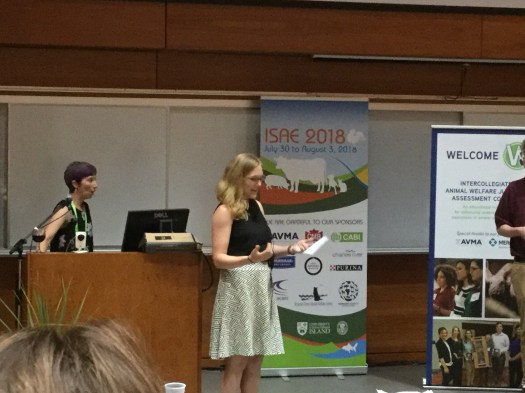
Curiosity also drove me to take part in the final event of the day, a workshop on Animal Welfare Assessment Contest. I have seen this activity discussed in ISAE since more than a decade, but in all honesty, I never engaged with  this North American concept of competing in how to evaluate animal welfare. It has always seemed rather alien to me: in Europe sports is the only activity we compete in at universities – outside the ongoing silent competition for the best marks of course. In a well organized session we got the taste of a real competition, got to try our hand at evaluating the welfare of working donkeys in two different contexts and watch the impressive performance of students with actual competition experience (Megan La Follette on the photo below).

9CB7BEDE-7284-4356-9B77-BF7BA9A4CD0B